


Care After Hospital Discharge for Elderly in Orange County
Care After Hospital Discharge for Elderly Parents in Orange County
By the Assisting Hands® Irvine & Dana Point · Updated August 1, 2026
A safe discharge starts before your parent leaves the hospital: confirm the medication list, lock in follow-up appointments, check the home for hazards, and arrange caregiver support for the first days back. Discharge planners at hospitals like Hoag, Providence Mission Hospital, and MemorialCare Saddleback assess what a patient will need — but families coordinate the transition home. Assisting Hands® Irvine & Dana Point, based in San Juan Capistrano and serving families throughout South Orange County, provides non-medical support during the critical first 72 hours after arrival. Call (949) 426-7300 to arrange a free in-home consultation before discharge day.
Key Takeaways
Hospital discharge planning in Orange County often gives families only hours to a few days to arrange everything a parent needs at home.
The first 72 hours after discharge carry the highest risk of setbacks and readmission — a written, sequenced plan matters most here.
Caregivers from Assisting Hands® Irvine & Dana Point are matched to each client by experience, skillset, and personality, and assist with personal care, meals, transportation, mobility, and medication reminders.
There are no long-term contracts. Call (949) 426-7300 for a free in-home consultation.
Hospital discharge planning in Orange County often gives families only hours to a few days to arrange everything a parent needs at home.
The first 72 hours after discharge carry the highest risk of setbacks and readmission — a written, sequenced plan matters most here.
Caregivers from Assisting Hands® Irvine & Dana Point are matched to each client by experience, skillset, and personality, and assist with personal care, meals, transportation, mobility, and medication reminders.
There are no long-term contracts. Call (949) 426-7300 for a free in-home consultation.
What Should You Prepare Before Hospital Discharge Day?

Preparation for discharge day starts long before a parent actually walks out of the hospital. At major Orange County facilities — Hoag Hospital, UCI Medical Center, Providence Mission Hospital, and MemorialCare Saddleback Medical Center — a discharge planner or social worker typically becomes involved whenever a senior or a patient with complex needs is being released. That professional carries real responsibility, but families still carry the heavier load once the paperwork is signed.
Adult children often get somewhere between a few hours and a few days to arrange everything a parent needs after leaving the hospital. That narrow window rarely feels like enough time. In practice, discharge planning tends to be compressed, and it frequently misses details families only discover once they’re home.
What does a hospital discharge planner actually cover?
Discharge planners review a patient’s clinical status and any physical limitations before release. They also explain what home health services have been ordered and how families should go about arranging them. Confirming these details in writing, rather than relying on memory, prevents gaps in care after hospital discharge for elderly patients.
Before discharge day arrives, families should:
Ask the discharge planner to list every ordered home health service in writing.
Confirm which limitations or restrictions apply to daily activities.
Identify whether transitional care will be needed immediately or within the first week.
Arrange post-surgery home care if the admission involved a procedure requiring recovery support.
Request a callback number for the discharge planner in case questions surface after leaving the building.
Ask the discharge planner to list every ordered home health service in writing.
Confirm which limitations or restrictions apply to daily activities.
Identify whether transitional care will be needed immediately or within the first week.
Arrange post-surgery home care if the admission involved a procedure requiring recovery support.
Request a callback number for the discharge planner in case questions surface after leaving the building.
Assisting Hands® Irvine & Dana Point serves families throughout South Orange County and can help translate discharge instructions into a workable plan at home.
What Steps Happen During the Discharge Meeting?
A discharge meeting exists to confirm that a patient leaves the hospital safely and receives the right level of support afterward. For Orange County families, this meeting sets the entire trajectory of care after hospital discharge for elderly parents — from where they go next to who checks on them daily. Missing a detail in this conversation often creates gaps that surface days later, once hospital staff are no longer available to fill them.
The meeting typically follows a predictable sequence:
The discharge planner reviews the parent’s medical status and explains why the hospital stay is ending.
The family and discharge planner discuss destination options together — home, a relative’s home, or a rehabilitation facility.
The team identifies follow-up needs, including nursing visits, physical therapy, occupational therapy, or speech therapy.
The planner outlines what must be arranged before departure, such as equipment, transportation, and home safety adjustments.
Families receive instructions for the days ahead, often tied to a broader checklist covering the transition from hospital to home.
The discharge planner reviews the parent’s medical status and explains why the hospital stay is ending.
The family and discharge planner discuss destination options together — home, a relative’s home, or a rehabilitation facility.
The team identifies follow-up needs, including nursing visits, physical therapy, occupational therapy, or speech therapy.
The planner outlines what must be arranged before departure, such as equipment, transportation, and home safety adjustments.
Families receive instructions for the days ahead, often tied to a broader checklist covering the transition from hospital to home.
What should families ask before leaving?
Ask exactly which therapies your parent needs and how soon those services must start. Clarifying this early prevents delays when transitional care providers in Orange County are contacted for scheduling. Ask about warning signs and follow-up appointments as well — gaps here are a common trigger for readmission. (For more on why this matters, see our guide to reducing hospital readmissions.)
How does this connect to long-term recovery?
The discharge meeting only covers the immediate handoff, not the full recovery arc. A complete plan extends through preparing the home, the first 72 hours, the first two weeks, and the first 30 days after arrival. For a parent recovering from surgery, arranging post-surgery home care for seniors during this window keeps the plan from falling apart once hospital oversight ends.
How Do You Prepare the Home and Arrange Transitional Care?

Preparing a home for a discharged parent takes planning across four areas: medications, mobility, meals, and support staffing. Adult children juggling careers rarely have time to research all four while also managing hospital paperwork. Skipping any one of them raises the odds of a setback that lands a parent back in the emergency room.
What makes coming home from the hospital so hard for families?
The transition itself, not just the illness, creates the strain. Keeping up with appointments, medications, and daily routines like grocery shopping and housework becomes difficult for a recovering senior who mainly needs rest. Families juggling jobs and their own households often discover there’s no realistic way to cover these tasks alone.
Transitional care programs in Orange County address that gap directly. Trained caregivers make regular visits designed to help seniors settle in safely and reduce the chance of another hospitalization. That structure matters most in the first two weeks home, when complications are most likely to surface.
Families can follow this sequence to arrange support before discharge day arrives:
Confirm the discharge date and request written care instructions from hospital staff.
Schedule a free in-home consultation with Assisting Hands® Irvine & Dana Point to assess the home and recovery needs.
Set up a caregiver schedule covering medication reminders, meal preparation, and mobility assistance — from a few hourly visits per week up to 24-hour care.
Arrange transportation for follow-up appointments before your parent leaves the hospital.
Confirm the discharge date and request written care instructions from hospital staff.
Schedule a free in-home consultation with Assisting Hands® Irvine & Dana Point to assess the home and recovery needs.
Set up a caregiver schedule covering medication reminders, meal preparation, and mobility assistance — from a few hourly visits per week up to 24-hour care.
Arrange transportation for follow-up appointments before your parent leaves the hospital.
What tasks do caregivers actually handle during recovery?
Post-surgery home care for seniors covers far more than medication reminders. Caregivers from Assisting Hands® Irvine & Dana Point assist with personal hygiene, meal preparation, light housekeeping, transportation, mobility support, safety and fall-prevention monitoring, cognitive stimulation, and companionship. As a licensed non-medical home care organization (HCO #304700345), our caregivers do not provide medical treatment — they work alongside any home health nurses or therapists the hospital has ordered, covering the daily-living support those clinical visits don’t.
Care after hospital discharge for elderly clients extends throughout South Orange County, including Dana Point, San Juan Capistrano, Laguna Niguel, Ladera Ranch, Irvine, Lake Forest, and San Clemente. Families across the region can request a free in-home consultation and build a discharge plan before the hospital bed is even vacated. For shorter engagements around a planned procedure, our short-term pre- and post-procedure care fits the same need on a smaller scale.
What Happens During the First 72 Hours Home?
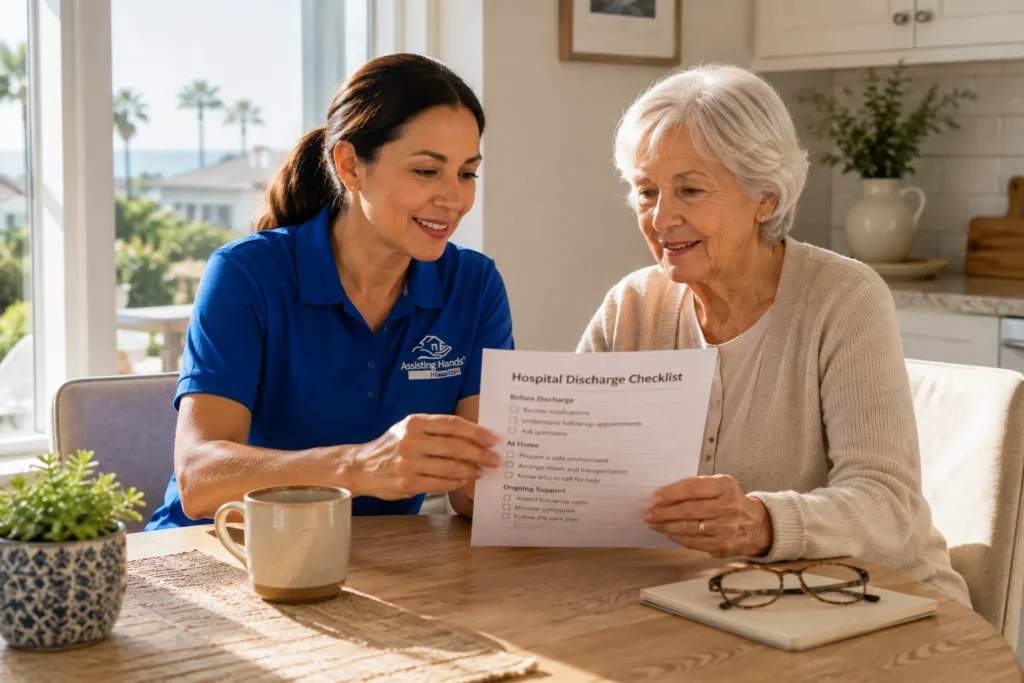
The first 72 hours after an elderly parent leaves an Orange County hospital largely determine whether recovery moves forward or stalls into a readmission. Recovery speed and readmission risk depend directly on how well the discharge plan is carried out at home. Families rarely receive this warning in advance, which is why the initial three days demand a clear, sequenced approach rather than guesswork.
Adult children typically walk out of the hospital holding a stack of discharge paperwork, handed over during rapid instructions while getting a parent settled into the car. Little of that information gets absorbed in the moment. Working through it methodically once home prevents missed medication doses, skipped follow-up calls, and confusion over activity restrictions.
What should families do first when they get home?
Review discharge paperwork line by line, flagging medication names, dosages, and timing.
Set up the home for safety: clear walkways, secure loose rugs, and place mobility aids within reach.
Confirm the follow-up appointment date and write it down where everyone can see it.
Watch for warning signs such as fever, confusion, or unusual pain, and know which symptoms require a call to the doctor.
Review discharge paperwork line by line, flagging medication names, dosages, and timing.
Set up the home for safety: clear walkways, secure loose rugs, and place mobility aids within reach.
Confirm the follow-up appointment date and write it down where everyone can see it.
Watch for warning signs such as fever, confusion, or unusual pain, and know which symptoms require a call to the doctor.
Why does this period matter so much for recovery?
The shift from round-the-clock hospital supervision to home ranks among the most critical phases in an older adult’s recovery, particularly after surgery. Post-surgery home care for seniors fills the gap that hospital staff once covered, catching problems before they escalate. Care after hospital discharge for elderly patients works best when a trained presence is available during those early, unpredictable days.
When families arrange transitional care through Assisting Hands® Irvine & Dana Point, we start with a caregiver match based on experience, skillset, and personality — and we assign the same caregiver consistently, so your parent has familiar support during the most fragile stretch of recovery.
What Common Discharge Mistakes Should Families Avoid?
Trusting the paperwork without a second review causes the most damage. Families walking out of an Orange County hospital often assume the discharge plan covers everything a parent needs — but a discharge planner’s job is to assess needs, not to arrange the day-to-day help that meets them. These are the mistakes we see most often:
Assuming “home health was ordered” means help is coming daily. Ordered home health usually means periodic nursing or therapy visits — often just one to three per week. Everything between those visits falls to the family.
Leaving the pharmacy run for later. New prescriptions should be filled before or on the way home, not the next morning. A missed first dose is one of the most common early setbacks.
Not lining up help until a crisis forces it. Arranging caregiver support after a fall or a missed medication is far more stressful than arranging it before discharge. A free consultation before discharge day costs nothing and locks in a plan.
Overestimating what one family member can sustain. A spouse or adult child covering every shift alone burns out quickly — often within the first two weeks. Building in relief from the start, whether through professional caregivers or respite care, keeps the whole plan durable.
Ignoring small warning signs. Confusion, appetite loss, or new unsteadiness in the first days home warrant a call to the doctor, not a wait-and-see. Caregivers trained to notice these changes are often the reason a small problem stays small.
Assuming “home health was ordered” means help is coming daily. Ordered home health usually means periodic nursing or therapy visits — often just one to three per week. Everything between those visits falls to the family.
Leaving the pharmacy run for later. New prescriptions should be filled before or on the way home, not the next morning. A missed first dose is one of the most common early setbacks.
Not lining up help until a crisis forces it. Arranging caregiver support after a fall or a missed medication is far more stressful than arranging it before discharge. A free consultation before discharge day costs nothing and locks in a plan.
Overestimating what one family member can sustain. A spouse or adult child covering every shift alone burns out quickly — often within the first two weeks. Building in relief from the start, whether through professional caregivers or respite care, keeps the whole plan durable.
Ignoring small warning signs. Confusion, appetite loss, or new unsteadiness in the first days home warrant a call to the doctor, not a wait-and-see. Caregivers trained to notice these changes are often the reason a small problem stays small.
Arrange Care Before Discharge Day

The best time to plan care after hospital discharge for an elderly parent is while they’re still in the hospital bed. Assisting Hands® Irvine & Dana Point offers free in-home consultations, matches each client with a consistent caregiver, and requires no long-term contracts — you keep us only as long as we’re exceeding your expectations.
If your parent is preparing to come home from a hospital stay anywhere in South Orange County, call (949) 426-7300 or schedule a free consultation. We’ll help you walk out of that discharge meeting with a plan that actually works at home.
Frequently Asked Questions
How much time do families typically get to prepare for hospital discharge?
Most Orange County hospitals, including Hoag, Providence Mission Hospital, and MemorialCare Saddleback, give families anywhere from a few hours to a few days’ notice before a parent is discharged. That short window is why confirming medications, follow-up appointments, and home safety in advance matters so much — there’s rarely time to sort out gaps after the fact.
What is included in a typical hospital discharge checklist for an elderly parent?
A solid checklist covers the medication list and pharmacy pickup, written follow-up appointment dates, any home health services that were ordered, home safety adjustments like clear walkways and secured rugs, transportation for the ride home and future appointments, and a plan for who will be present during the first 72 hours.
Why are the first 72 hours after discharge so important?
The first 72 hours carry the highest risk of setbacks and hospital readmission, since a parent is adjusting from round-the-clock hospital supervision to managing medications, mobility, and daily routines at home. A sequenced plan and a trained presence during this window catch small problems before they become emergencies.
Does home health ordered by the hospital cover daily care needs?
Not usually. Ordered home health typically means periodic nursing or therapy visits — often just one to three times a week. Everything that happens between those visits, including meals, mobility support, and medication reminders, falls to the family unless additional caregiver support is arranged.
How do I arrange caregiver support before my parent leaves the hospital?
Call Assisting Hands® Irvine & Dana Point at (949) 426-7300 to schedule a free in-home consultation. We can assess the home and recovery needs, match a consistent caregiver by experience and personality, and have a care schedule ready before your parent walks out the hospital doors.