

What June’s Alzheimer’s Awareness Month Means for Orange County Families: A Practical Guide to Dementia Care at Home
Every June, the Alzheimer’s Association invites the country to wear purple, light candles on June 20th for The Longest Day, and pay closer attention to a quiet truth most of us avoid until it knocks on our own door.
That truth: Alzheimer’s disease and other forms of dementia don’t just touch the person diagnosed. They reshape an entire family — often a daughter, often a wife, often a spouse who never expected to become a caregiver. In Dana Point, San Juan Capistrano, Laguna Niguel, and across South Orange County, the families we work with at Assisting Hands® talk about the same things: a husband who keeps misplacing his keys and getting upset, a mother who is calm all day and then unrecognizable by 5 p.m., a father who has started arguing with his reflection in the bedroom mirror.
If any of this sounds familiar, June is a good month to slow down, learn what’s possible, and accept that asking for help isn’t giving up. It’s getting better at this.
This guide walks through what families in South Orange County should know right now — the scope of what we’re facing, recent news from the medical community that families are already asking us about, what dementia care at home actually looks like day-to-day, and how to tell when it’s time to bring in a professional caregiver.
Why June Matters — and Why the Numbers Are Different This Year

The Alzheimer’s Association designates June as Alzheimer’s & Brain Awareness Month for two reasons. First, the disease still carries a stigma that quiet awareness campaigns aim to soften. Second — and more practically — the bulk of medical research news, clinical trial updates, and policy proposals tied to dementia tend to surface in the late spring and early summer, so June ends up being a month when families have more information to make decisions with.
That’s especially true this year. Three things happened in the last six weeks that are worth knowing about:
- The FDA approved Auvelity on April 30, 2026 — the first non-antipsychotic treatment specifically for agitation linked to Alzheimer’s disease. Until now, families dealing with agitation often watched a loved one prescribed an off-label antipsychotic and worried about the side effects. Auvelity isn’t a cure, and it isn’t right for everyone, but it gives physicians a new tool to discuss.
- Bipartisan legislation advanced in the U.S. House on May 21 to expand dementia care training, particularly in rural and underserved areas. Orange County isn’t rural, but the bill includes provisions for caregiver respite funding that may eventually reach California families.
- A new tau-targeting therapy called diranersen showed encouraging early-stage results in May, building on the slow but real progress in disease-modifying treatments. It’s still in clinical trials. It’s not available to most patients yet. But it’s a reason to keep asking your loved one’s neurologist about study eligibility.
We mention these not to give medical advice — that conversation belongs with your physician — but because families are searching for them, hearing about them from friends, and trying to figure out what they mean. They mean progress is happening, slowly. That’s worth holding onto.
What “Dementia Care at Home” Actually Looks Like
When most families first reach out to us, they imagine “memory care” means a facility. Sometimes it does. But more often, especially in the early and middle stages, the most meaningful, dignifying option is care delivered at home — in the same kitchen, the same garden, the same favorite chair near the window where your father has read the newspaper every morning for thirty years.
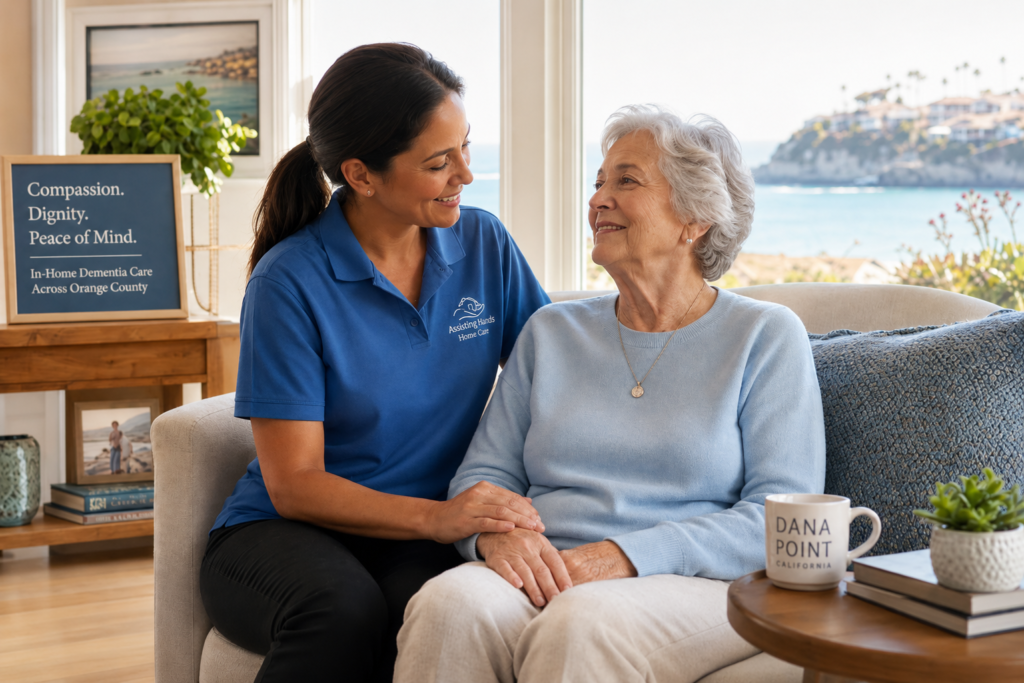
In-home dementia care at its best is a partnership. A trained caregiver shows up at a consistent time, knows your loved one’s routine, remembers what soothes them, and quietly takes the friction out of the day. The work doesn’t look dramatic. It looks like:
- Gentle redirection when a question is asked for the eighth time, without making anyone feel ashamed of asking
- Simple, consistent routines — same breakfast time, same morning walk path, same caregiver if possible — because predictability is medicine for an anxious brain
- Skilled help with personal care (bathing, dressing, mobility) delivered with the kind of patience that doesn’t come from rushing
- Meal preparation designed around what your loved one actually enjoys eating, not just what’s “good for them”
- Watchful supervision for the moments that frighten families most — wandering, falls, leaving the stove on
- Companionship that holds steady through the hard days, when the personality you knew flickers and returns and flickers again
What in-home dementia care isn’t: a babysitter, a maid, or a stranger who shows up with a clipboard. The caregivers we send into homes across Dana Point, San Juan Capistrano, Laguna Niguel, and the surrounding South OC communities are trained, vetted, and matched with each family with care. Many have been doing this work for years. Many have walked a parent or grandparent through the same disease.
Navigating Dementia Care: A Guide for Orange County Families
 overnight or evening care often changes the whole experience — not because the disease changes, but because the family caregiver finally gets to rest.
The Longest Day — June 20, 2026
For families looking to mark the month meaningfully, June 20 is the longest day of the year — the summer solstice — and the Alzheimer’s Association’s annual Longest Day fundraising event. Families honor a loved one by spending the day doing something they loved: gardening, sailing in the harbor, painting, walking the cliffs at Salt Creek. Some families do it together. Some do it alone and bring photos.
In South Orange County, the Orange County chapter of the Alzheimer’s Association runs the annual Walk to End Alzheimer’s later in the fall, but June 20 is the day to start preparing — to volunteer, to register, or simply to spend an afternoon with the person whose mind is changing, doing something the disease hasn’t taken from them yet.
How South OC Families Know It’s Time to Ask for Help
The single question we hear more often than any other is some version of: “How do we know it’s time?”
There is no single moment. There is, instead, a quieter cluster of signs that the family has been managing for a long time without naming what they’re doing. Some of the ones we see most:
- The primary family caregiver is burning out. Sleep is fragmented. Resentment that nobody wants to admit is creeping in. The marriage is straining. Adult children are getting tired of weekend trips down PCH that always end with someone in tears.
- Falls are happening, or nearly happening. The bathroom rug. The step down to the garage. The familiar route to the mailbox that suddenly looks different.
- Wandering has begun. A neighbor returns your father at 9 p.m. He doesn’t remember leaving. He’s not embarrassed — he’s confused why everyone else seems alarmed.
- Personal care is being avoided. Showers are skipped. Clothes are worn for days. The person who once cared about presentation no longer does.
- The decisions are getting harder. Medications, doctors’ appointments, finances, future planning. The family is carrying too much logistical weight on top of the emotional weight.
None of these alone means everything has to change. All of them together usually means it’s time to talk to someone who has helped other families through this. That’s most of what a first conversation with our team looks like — not a sales pitch, just a careful walk-through of what’s happening, what’s possible, and what an hour or two of professional care per day might do.
What Makes Care Different in South Orange County
Aging at home in South OC is its own kind of opportunity. The communities here — from the Lantern District in Dana Point up through San Juan Capistrano and into Laguna Niguel and Coto de Caza — are made for people in the long arc of their lives. Walkable streets. Coastal weather that supports outdoor time year-round. Long-standing friendships that the right caregiver can help preserve, not replace.
What we focus on for families across South OC:
- Hyperlocal caregivers who know the area, the streets, the senior centers, the right grocery stores, the local hospitals (Mission Hospital in Mission Viejo, Saddleback Memorial in Laguna Hills), and the small daily routines that make a person feel at home.
- Flexible schedules because dementia doesn’t follow a clock. Some families need a few hours of help in the morning. Some need overnight. Some need a transition into 24-hour live-in care as the disease progresses.
- Continuity of caregiver wherever possible. A familiar face is the single biggest comfort to someone whose memory of unfamiliar faces is fading.
- Veteran-aware benefits guidance. Many of our South OC families are eligible for VA Aid and Attendance benefits to help with the cost of care. We can point families toward the right starting place.
Frequently Asked Questions
Is in-home dementia care covered by Medicare?
Medicare generally does not cover non-medical in-home care for dementia (the day-to-day companionship and personal care work). It does cover short stretches of home health care prescribed by a physician — typically for skilled nursing or therapy after a hospital stay. Long-term in-home dementia care is most often paid for through long-term care insurance, VA Aid and Attendance benefits for qualifying veterans, or private pay. Our team can walk you through the realistic financial picture for your family.
When should we talk to a doctor about new symptoms?
Any new symptom — sudden changes in behavior, new agitation, falls, hallucinations, or rapid decline — deserves a call to your primary care physician or neurologist. Sometimes what looks like worsening dementia is actually a urinary tract infection, medication interaction, or dehydration. The earlier those are caught, the less harm they cause.
What is sundown syndrome, and how is it different from regular evening confusion?
Sundown syndrome is a specific pattern of increased confusion, agitation, or restlessness that emerges in the late afternoon and evening hours, often coinciding with the change in natural light. Unlike occasional evening tiredness, sundowning tends to follow a daily pattern and often worsens as the disease progresses. Families can sometimes ease it with environmental changes (lighting, routine, reducing overstimulation), but persistent or severe sundowning should be discussed with your loved one’s physician.
Can in-home care delay the move to a memory care facility?
Often, yes — sometimes for years. The right blend of professional in-home dementia care, family support, and medical oversight can allow many people with mild to moderate dementia to remain at home safely for an extended time. The decision to transition to a memory care facility is personal and depends on safety, the progression of the disease, and the family’s resources and preferences.
How do we know if a caregiver is a good match for our family?
A good caregiver match isn’t only about skills (though training and experience matter). It’s about temperament, communication style, and the small things — does your mother feel calm in their presence? Does your father respond to their voice? At Assisting Hands® Irvine & Dana Point, we spend real time on the matching process before any introduction, and we adjust if the first match isn’t right. The goal is the relationship, not the resume.
What about the new FDA-approved Auvelity for Alzheimer’s agitation?
Auvelity (dextromethorphan and bupropion) received FDA approval on April 30, 2026 for the treatment of agitation associated with Alzheimer’s disease. It’s the first non-antipsychotic medication approved for this specific use. Whether it’s appropriate for your loved one is a conversation for their physician — we can’t and don’t make medical recommendations. We do know that families have been asking about it, so it’s worth bringing up at the next neurology visit.
A Final Word for June
If you’ve read this far, there’s a chance you’re carrying something heavy. Maybe you’ve been carrying it for a while. Maybe you’re the daughter making this decision alone because your siblings live far away. Maybe you’re the spouse who promised in 1972 that you’d handle whatever came, and now what’s come is bigger than one person should hold.
June is a good month to put some of that weight down. To ask for help and not feel diminished by asking. To learn what’s possible. To call someone who has walked alongside hundreds of South OC families through exactly this kind of slow, complicated change — and who will simply listen first.
If that conversation is one you’re ready to have, our Dana Point team is here.
Call us at (949) 426-7300 for a no-pressure, no-obligation conversation about what’s happening with your loved one and what in-home dementia care could look like for your family.
Or request a callback online and we’ll get back to you within one business day.
We serve families across Dana Point, San Juan Capistrano, Laguna Niguel, San Clemente, Coto de Caza, Rancho Mission Viejo, and Irvine — and we’d be honored to be useful to yours.